



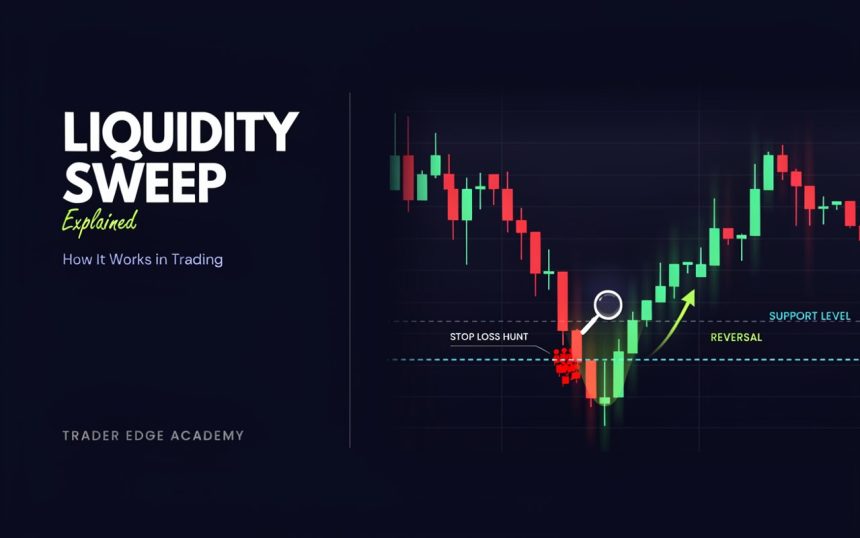
What Is a Liquidity Sweep?
A liquidity sweep is a market move that briefly pushes beyond a price level where many traders have placed stop-loss orders or pending orders. After collecting that liquidity, the price may reverse or continue in the same direction.
In simple terms, traders often place stops around obvious highs and lows. When price reaches those areas, a large number of orders can be triggered. This creates liquidity for other market participants and can sometimes lead to a sharp reaction.
Understanding liquidity in trading can help traders read price action more carefully instead of reacting to every breakout.
How Does a Liquidity Sweep Work?
A liquidity sweep usually develops around an obvious market level. This could be a previous high, previous low, support, resistance, or a clearly visible range.
For example, imagine a currency pair has repeatedly found resistance near $1.1000. Many traders may place stop-loss orders just above that level. If price suddenly moves to $1.1020, those stops can be triggered.
If price then quickly falls back below $1.1000, traders may interpret the move as a potential liquidity sweep rather than a genuine breakout.
However, a sweep does not guarantee a reversal. Price can also break through a level and continue moving in the same direction. That is why confirmation matters.
Liquidity Zones and Stop Orders
Liquidity zones are areas where many orders may be concentrated. Common examples include:
- Previous swing highs
- Previous swing lows
- Equal highs or equal lows
- Major support and resistance
- Consolidation ranges
- Psychological price levels
These areas attract attention because traders tend to make similar decisions around obvious prices.
Liquidity Sweep Trading: How Traders Use It
Liquidity sweep trading focuses on identifying areas where liquidity may be sitting and then watching how price behaves after reaching them.
A basic approach can involve three steps.
1. Identify a Clear Liquidity Level
First, look for an obvious high or low. The more visible the level is, the more likely traders may have orders around it.
2. Wait for Price to Sweep the Level
Instead of entering immediately, watch whether price moves beyond the level. A wick beyond a previous high or low can be an important clue.
3. Look for Confirmation
After the sweep, traders may look for signs that price is rejecting the level. These can include a strong reversal candle, a change in short-term market structure, or a return inside the previous trading range.
This approach can reduce impulsive entries, although it does not eliminate trading risk.
Bullish and Bearish Liquidity Sweeps
Liquidity sweeps can happen on either side of the market.
Bullish Liquidity Sweep
A bullish setup may occur when price moves below a previous low, triggers sell-side liquidity, and then quickly returns above that low. If buyers take control afterward, some traders view this as a possible bullish reversal setup.
Bearish Liquidity Sweep
A bearish setup can happen when price moves above a previous high, takes buy-side liquidity, and then falls back below the level. A subsequent decline may suggest that the breakout failed.
The key idea is not simply that price crossed a level. Instead, traders study what happens after the level is taken.
Liquidity Sweep vs. Liquidity Grab
The terms “liquidity sweep” and “liquidity grab” are often used interchangeably, although traders may use them slightly differently.
A liquidity sweep generally describes price taking liquidity around a known level. A liquidity grab can also describe a quick move designed to trigger clustered orders before price reverses.
There is no universal definition used by every trader. Therefore, it is more useful to focus on the actual price behavior than on the label.
Common Mistakes When Trading Liquidity Sweeps
Even when the concept looks simple, traders can make several mistakes.
Entering too early: A price move beyond a level does not automatically mean a reversal is coming.
Ignoring the larger trend: A sweep against a strong trend may behave differently from one occurring near a major reversal area.
Using unclear levels: Random highs and lows may not provide the same information as obvious liquidity zones.
Skipping risk management: A liquidity sweep can fail. Stop-loss placement, position sizing, and risk limits remain important.
Treating every wick as a sweep: Not every candle wick represents meaningful liquidity-taking activity.
FAQ About Liquidity Sweeps
What is a liquidity sweep in simple terms?
A liquidity sweep is when price moves beyond an important high or low, triggers orders around that level, and then may reverse or continue.
Is a liquidity sweep always a reversal?
No. A sweep can be followed by a reversal, but price may also continue in the same direction. Confirmation is important.
Can beginners use liquidity sweep trading?
Yes, beginners can study the concept, but they should practice on historical charts or a demo account before risking real money.
Which markets have liquidity sweeps?
Liquidity sweeps can appear in forex, stocks, futures, and cryptocurrency markets. Their behavior depends on market conditions and available liquidity.
Conclusion
A liquidity sweep provides a useful way to understand why price sometimes moves beyond an obvious high or low before making another significant move. By studying liquidity zones, market structure, and price confirmation together, traders can develop a more disciplined approach to chart analysis.
Still, no setup is guaranteed to work. Use proper risk management and avoid making trading decisions based on a single signal.