



Introduction
If you’ve ever wondered when was 16th century, you’re not alone. Many people confuse centuries with the years they represent. Understanding centuries is important for studying history, literature, and world events.
The 16th century was one of the most influential periods in human history. It witnessed the Renaissance, major religious changes, global exploration, scientific discoveries, and the rise of powerful empires. In this guide, you’ll learn exactly what year was the 16th century, what happened during this period, and why it remains so important today.
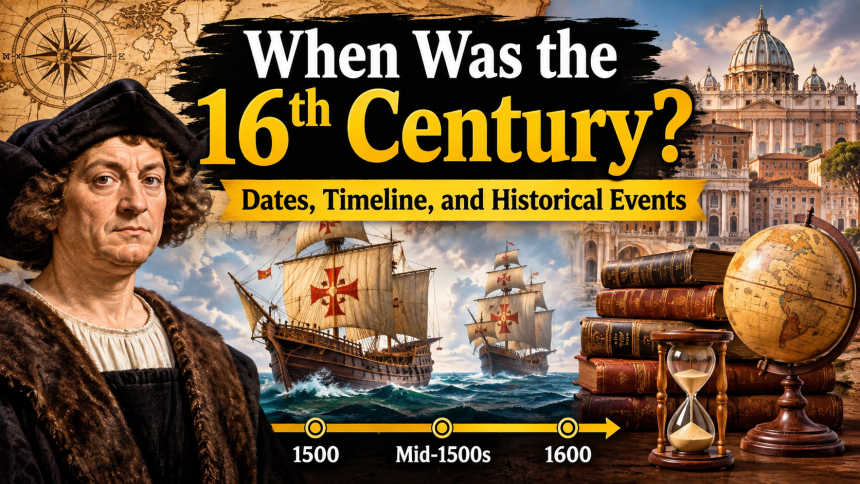
When Was the 16th Century?
The 16th century lasted from January 1, 1501, to December 31, 1600. Although many people think it began in 1500, centuries officially start with the year ending in 01 and finish with the year ending in 00.
Quick Timeline
| Century | Years |
|---|---|
| 15th Century | 1401–1500 |
| 16th Century | 1501–1600 |
| 17th Century | 1601–1700 |
What Is the 16th Century?
The question what is the 16th century refers to the period between 1501 and 1600. It was an era of dramatic political, cultural, religious, and scientific transformation across the world.
During these one hundred years, societies experienced rapid change through exploration, trade, technological improvements, and the spread of new ideas.
Historians often describe this century as the bridge between the medieval world and the modern age.
What Year Was the 16th Century?
Many students ask, what year was the 16th century?
The answer is simple:
- It began in 1501
- It ended in 1600
- It lasted exactly 100 years
Remember this easy rule:
The nth century includes years ending in 01 through years ending in 00.
For example:
- 1500 belongs to the 15th century
- 1501 begins the 16th century
- 1600 is the final year of the 16th century
What Happened in the 1500s?
If you’re asking what happened in the 1500s, you’ll discover one of history’s most exciting periods. Major events reshaped governments, religion, science, and global trade.
The Renaissance Flourished
The Renaissance reached its height across Europe. Artists, architects, and writers created masterpieces that continue to inspire people today.
Famous figures included:
- Leonardo da Vinci
- Michelangelo
- Raphael
Their work transformed art, engineering, and education.
The Protestant Reformation
In 1517, Martin Luther challenged practices within the Catholic Church by publishing his famous Ninety-Five Theses.
This movement led to:
- New Christian denominations
- Religious reform
- Political conflicts throughout Europe
The Age of Exploration
European explorers expanded global knowledge by sailing to new lands.
Notable explorers included:
- Ferdinand Magellan
- Vasco da Gama
- Hernán Cortés
- Francisco Pizarro
Their voyages opened new trade routes while also bringing major cultural and political changes.
Scientific Progress
Scientists questioned traditional beliefs and laid the groundwork for modern science.
Important achievements included:
- Nicolaus Copernicus proposing the heliocentric model
- Advances in medicine
- Improvements in navigation and mapmaking
Powerful Empires Expanded
During this period, some of history’s most powerful empires reached the height of their strength and influence, including:
- The Ottoman Empire
- The Spanish Empire
- The Mughal Empire
- The Ming Dynasty in China
These empires shaped politics, trade, and culture across continents.
16th Century Europe: A Time of Transformation
Politics
Kings and queens strengthened their kingdoms, creating more centralized governments.
Important rulers included:
- Henry VIII of England
- Elizabeth I
- Charles V
- Philip II of Spain
Religion
Religious debates transformed Europe through the Protestant Reformation and the Catholic Counter-Reformation.
These events influenced politics, education, and daily life for centuries.
Culture
European culture flourished through literature, music, architecture, and painting.
Printing presses helped books spread faster than ever before, increasing literacy and education.
Economy
International trade expanded dramatically.
New goods such as spices, silver, and textiles connected Europe with Asia, Africa, and the Americas, creating a truly global economy.
Why the 16th Century Still Matters Today
The influence of the 16th century can still be seen in modern life.
Many ideas and institutions that shape today’s world began during this period, including:
- Modern scientific thinking
- Global trade networks
- Religious diversity
- Nation-building
- International exploration
- Artistic innovation
Studying this century helps explain how today’s world developed.
Timeline of Major 16th Century Events
| Year | Event |
|---|---|
| 1501 | Beginning of the 16th century |
| 1517 | Martin Luther begins the Protestant Reformation |
| 1519–1522 | Magellan’s expedition completes the first circumnavigation of Earth |
| 1521 | Fall of the Aztec Empire |
| 1543 | Copernicus publishes On the Revolutions of the Heavenly Spheres |
| 1558 | Elizabeth I becomes Queen of England |
| 1588 | Defeat of the Spanish Armada |
| 1600 | End of the 16th century |
Common Misunderstandings About the 16th Century
Many people mistakenly believe:
- The 16th century started in 1500.
- Every century begins with years ending in “00.”
In reality:
- The first century began with Year 1.
- Therefore, each new century starts with a year ending in 01.
This is why 1501–1600 defines the 16th century.
Frequently Asked Questions
When was the 16th century?
The 16th century lasted from 1501 to 1600.
What year was the 16th century?
The years 1501 through 1600 make up the 16th century.
What happened in the 1500s?
The 1500s included the Renaissance, the Protestant Reformation, global exploration, scientific discoveries, and the expansion of powerful empires.
What is the 16th century known for?
It is known for cultural revival, religious reform, overseas exploration, scientific progress, and major political change.
Why is the 16th century important?
The century shaped modern science, global trade, art, religion, and international relations, leaving a lasting impact on world history.
Conclusion
Understanding when was 16th century makes studying history much easier. The period from 1501 to 1600 witnessed extraordinary achievements in art, science, exploration, religion, and politics. From the Renaissance to the Age of Exploration, the century changed the course of civilization and laid the foundation for the modern world.
If you enjoy learning about history, explore other historical timelines and centuries to better understand how today’s world came to be.