



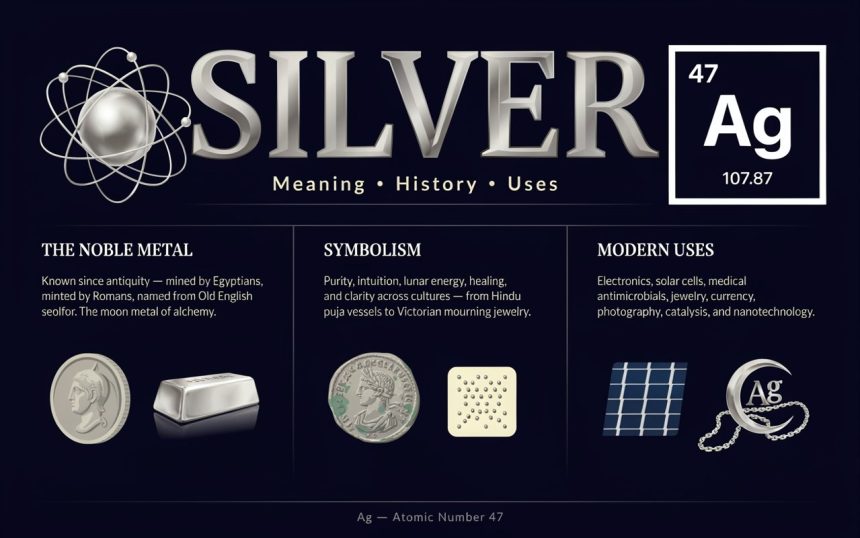
Introduction
The silver symbol is Ag, a two-letter abbreviation used to identify silver as a chemical element. Silver has been valued for thousands of years because of its attractive appearance, rarity, durability, and useful physical properties. Today, it remains important in jewelry, electronics, medicine, photography, solar technology, and many other industries.
But why is silver represented by Ag instead of a symbol based on the English word “silver”? The answer comes from the element’s historical name and its Latin roots.
In this guide, you will learn what the silver symbol means, where Ag comes from, where silver appears on the periodic table, and why this metal continues to be useful in modern life.
What Is the Silver Symbol?
The silver symbol is Ag, which is the official chemical symbol for the element silver.
The symbol comes from the Latin word argentum, an ancient name associated with silver. The first letter is capitalized, while the second letter is lowercase, so the correct form is Ag, not AG or ag.
Quick Facts About Silver
| Property | Detail |
|---|---|
| Element | Silver |
| Chemical symbol | Ag |
| Atomic number | 47 |
| Atomic mass | About 107.87 u |
| Group | 11 |
| Period | 5 |
| Block | d-block |
| Classification | Transition metal |
| Latin name | Argentum |
| Appearance | Shiny, metallic white |
The Ag symbol is used worldwide in chemistry, science education, laboratory work, and technical applications.
Why Is Silver Called Ag?
The reason silver has the Ag symbol is linked to its Latin name, argentum.
Unlike some elements whose symbols closely match their English names, silver uses a symbol based on an older language. The Latin term argentum is connected with the idea of shining or bright metal and is the historical source of the modern chemical abbreviation Ag.
This is not unusual in the periodic table. Several elements have symbols that come from Latin or other historical names rather than their modern English names.
For example:
- Silver → Ag from argentum
- Gold → Au from aurum
- Iron → Fe from ferrum
- Sodium → Na from natrium
- Potassium → K from kalium
Therefore, when you see Ag in a chemistry textbook, laboratory report, or periodic table, it refers specifically to silver.
Silver on the Periodic Table
Silver occupies an important position in the silver periodic table entry.
With an atomic number of 47, On the periodic table, silver occupies Group 11 in Period 5, placing it among the transition metals. It belongs to the transition metals, a broad category known for useful properties such as strength, electrical conductivity, and distinctive chemical behavior.
Where Is Silver Located?
Silver sits alongside other well-known metals in Group 11:
- Copper (Cu)
- Silver (Ag)
- Gold (Au)
These elements share several chemical characteristics. Silver, however, stands out because it is an exceptionally good conductor of electricity and has a highly reflective surface.
Its position on the periodic table also helps scientists understand its electron structure and chemical reactions.
Ag Element: Key Properties of Silver
The Ag element has several properties that make it valuable far beyond jewelry and decorative objects.
1. Excellent Electrical Conductivity
Silver is widely recognized as the best electrical conductor among the metals. This makes it useful in specialized electrical and electronic components.
Although its cost limits its use in ordinary household wiring, silver can be found in applications where high conductivity is especially important.
2. High Thermal Conductivity
Silver also transfers heat efficiently. This property contributes to its use in certain industrial and technical applications.
3. Bright Metallic Appearance
Pure silver has a distinctive white, metallic appearance. It can be polished to produce a bright shine, which is one reason it has been popular for jewelry, coins, ornaments, and tableware.
4. Malleability and Ductility
Silver can be shaped and worked without breaking easily. It can also be drawn into thin wires, making it useful for manufacturing and electrical applications.
5. Antimicrobial Properties
Silver compounds and silver-containing materials have antimicrobial characteristics. For this reason, silver has been used in certain medical, water-treatment, and hygiene-related applications.
However, the presence of silver does not automatically make every silver-containing product safe or suitable for medical use.
What Is Silver Used For?
Understanding the silver symbol is only part of the story. Silver’s physical and chemical properties explain why this element has remained important for centuries.
Jewelry and Decorative Items
Jewelry is one of the most familiar uses of silver. Rings, necklaces, bracelets, earrings, and other items are commonly made from silver alloys.
Pure silver is relatively soft, so jewelry is often made with sterling silver, which combines silver with small amounts of other metals to improve durability.
Electronics
Silver’s excellent electrical conductivity makes it valuable in electronics. It can be used in contacts, conductive materials, switches, and other specialized components.
Solar Technology
Silver is also used in the production of some solar panels. Conductive silver-based materials help move electrical current generated by solar cells.
Coins and Collectibles
Silver has a long history as a material for coins. Many historic currencies used silver because the metal was scarce, durable, attractive, and widely valued.
Today, silver coins are also produced for collectors and investors.
Photography
Silver compounds played a major role in traditional photographic film. Although digital photography has greatly reduced this use, silver-based photographic chemistry remains an important part of the history of photography.
Silver vs. Sterling Silver
A common source of confusion is the difference between pure silver and sterling silver.
Pure silver contains a very high percentage of silver but is relatively soft. Sterling silver, on the other hand, typically contains 92.5% silver, with the remaining portion made up of other metals, often copper.
This additional metal makes sterling silver harder and more practical for everyday jewelry and objects.
You may see markings such as 925 on sterling silver items. The number indicates that the material contains 92.5% silver.
Therefore, the presence of the Ag symbol identifies the chemical element silver, while a hallmark such as 925 can provide information about the purity of a silver product.
Silver’s Historical Importance
Silver has played an important role in human history for thousands of years.
Ancient civilizations used silver for ornaments, household objects, religious items, and currency. Because silver was relatively rare and visually appealing, it became associated with wealth and status.
Its role as money was particularly significant. Silver coins were used across different civilizations and remained an important form of currency for long periods.
The discovery and development of major silver deposits also influenced trade, economies, and international commerce.
Even though modern currencies are no longer based on silver in the way many historical currencies were, the metal continues to have economic and industrial importance.
Silver Symbol vs. Silver Name
The English word silver and the chemical symbol Ag may seem unrelated at first. However, chemical symbols often preserve historical language.
The word “silver” has Germanic linguistic roots, while Ag comes from the Latin argentum. This historical difference explains why the element symbol does not simply use the first two letters of the English word.
So, if someone asks, “What is the element symbol of silver?”, the direct answer is:
The element symbol of silver is Ag, derived from the Latin name argentum.
This simple fact makes silver easy to identify on any standard periodic table.
Why the Silver Symbol Matters
Chemical symbols provide a universal way for scientists and students to identify elements without relying on different languages.
For example, a chemistry equation may contain Ag rather than spelling out “silver.” This makes scientific communication shorter and more consistent.
The silver symbol can also appear in:
- Chemical formulas
- Laboratory notes
- Scientific research
- Periodic tables
- Industrial documents
- Educational materials
- Materials science
- Electronics research
Knowing Ag therefore makes it easier to understand chemistry and technical information involving silver.
Frequently Asked Questions About the Silver Symbol
What is the silver symbol?
The chemical symbol for silver is Ag. The Ag symbol traces its origins to the Latin name argentum, the historical term for silver.
What is silver’s atomic number?
Silver has an atomic number of 47, meaning a neutral silver atom contains 47 protons.
Where is silver on the periodic table?
Silver is located in Group 11 and Period 5 of the periodic table. It is classified as a transition metal.
Why is silver’s symbol Ag instead of Si?
The symbol Ag comes from the Latin word argentum, which is the historical name for silver. Si, meanwhile, is the symbol for silicon.
Is Ag the symbol for silver?
Yes. Ag is the internationally recognized chemical symbol for silver. The first letter is uppercase and the second is lowercase.
Conclusion
The silver symbol, Ag, represents one of the world’s best-known precious metals. Its symbol comes from the Latin name argentum, explaining why it differs from the English word “silver.”
With an atomic number of 47, silver belongs to Group 11 of the periodic table and is valued for its excellent electrical conductivity, attractive appearance, workability, and wide range of applications. From jewelry and historic coins to electronics and solar technology, silver continues to play an important role in modern society.
If you are studying chemistry or researching precious metals, remembering Ag = silver is a simple but useful starting point. Explore the periodic table further to discover how silver compares with gold, copper, and other elements.