



Introduction
Few natural events sound as intimidating as a supervolcano eruption. Unlike ordinary volcanic eruptions, these rare events can release enormous quantities of ash, gases, and volcanic material over a huge area. That scale is why super volcanoes have attracted so much scientific attention.
But what exactly makes a volcano a supervolcano? Where are these systems found, and what could happen if one experienced a massive eruption?
In this guide, we will explain how supervolcanoes develop, look at some of the best-known examples, and examine the frequently asked question: what would happen if Yellowstone erupted? We will also separate realistic scientific expectations from exaggerated disaster scenarios.
What Are Super Volcanoes?
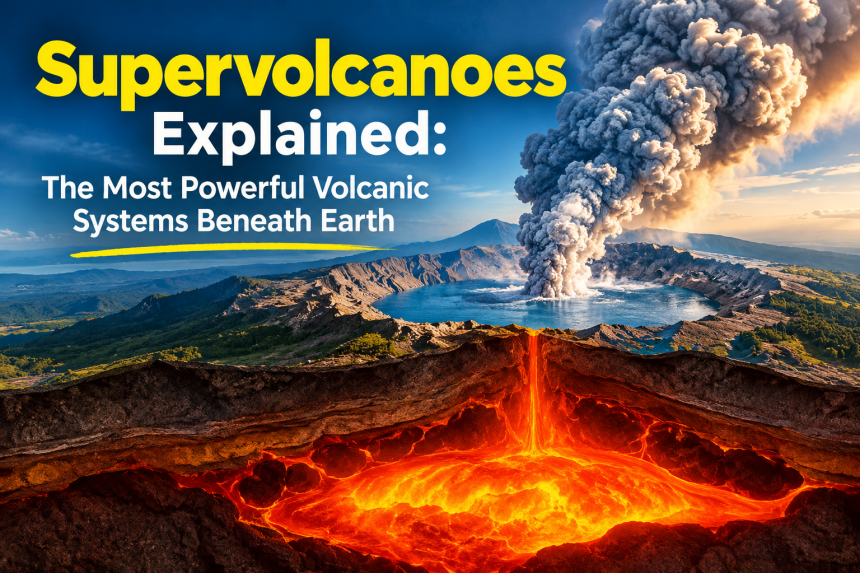
A supervolcano is a volcanic system capable of producing an exceptionally large explosive eruption. Scientists commonly use the term for eruptions rated VEI 8, the highest level on the Volcanic Explosivity Index.
A supervolcano does not necessarily look like a giant cone-shaped mountain. Many are associated with enormous underground magma systems and calderas, which are large depressions formed when the ground collapses after a major eruption.
How Does a Supervolcano Form?
Deep beneath Earth’s surface, heat can cause rock to melt and produce magma. In certain geological settings, large amounts of magma can accumulate beneath the crust.
Over very long periods, pressure and geological changes may contribute to an eruption. If an exceptionally large quantity of volcanic material is expelled, the eruption can create a huge caldera.
These processes normally take thousands or even millions of years, so supervolcanoes should not be thought of as ordinary volcanoes simply waiting to explode.
Where Are the Largest Supervolcanoes Found?
Several volcanic systems around the world have produced enormous eruptions in Earth’s geological past. Some of the best-known examples include Yellowstone in the United States, Toba in Indonesia, Taupō in New Zealand, and the Phlegraean Fields in Italy.
Yellowstone Supervolcano
Yellowstone ranks among the best-known volcanic systems on Earth, attracting significant scientific and public interest. It sits above a major geothermal region and contains a large caldera created by past eruptions.
Yellowstone has undergone several powerful eruptions throughout its long and complex geological past. However, that history does not mean another massive eruption is imminent.
Scientists continuously monitor Yellowstone using seismic activity, ground deformation, gas measurements, and other observations.
Toba
Lake Toba in Indonesia occupies a giant caldera produced by a massive prehistoric eruption. The Toba eruption approximately 74,000 years ago is among the largest known explosive eruptions in Earth’s recent geological history.
Its enormous scale makes Toba an important subject for researchers studying how exceptionally large eruptions can affect climate and ecosystems.
Taupō
New Zealand’s Taupō volcanic zone is another important area of volcanic activity. Taupō has experienced major eruptions during the past several thousand years and remains closely monitored.
What Would Happen If Yellowstone Erupted?
One of the most common questions about supervolcanoes is what would happen if Yellowstone erupted.
The answer depends heavily on the size and type of eruption. Yellowstone could experience relatively small volcanic or hydrothermal activity without producing a civilization-scale catastrophe.
A hypothetical extremely large eruption could produce several major effects:
- Large quantities of volcanic ash could enter the atmosphere.
- Areas near the eruption could experience severe volcanic hazards.
- Volcanic ash could interfere with flights over large areas, causing widespread disruptions to air travel.
- Agriculture and infrastructure could face serious problems.
- Atmospheric particles and volcanic gases could temporarily influence climate.
- Cleanup and economic disruption could continue long after the eruption.
However, popular descriptions sometimes portray Yellowstone as producing a guaranteed worldwide apocalypse. That is not how scientists generally describe the situation.
What Will Happen If Yellowstone Erupts?
There is no single answer because the consequences would depend on the eruption’s size, location, duration, wind patterns, and amount of material released.
A smaller eruption would have dramatically different consequences from a rare, enormous caldera-forming eruption.
It is also important to understand that volcanic hazards would not be identical everywhere. Communities closest to the eruption would face different risks from people hundreds or thousands of kilometers away.
Could Yellowstone Cause a Global Winter?
A very large explosive eruption could inject substantial amounts of sulfur dioxide and other particles into the atmosphere. These materials can affect sunlight reaching Earth’s surface and potentially cause temporary cooling.
Scientists study ancient eruptions to understand these effects. However, the exact climate response to any future eruption would depend on many variables, making dramatic predictions difficult.
Why Supervolcanoes Are So Powerful
The power of a supervolcano comes from the enormous volume of magma and volcanic material involved rather than simply the height of the volcano.
During a major eruption, explosive expansion of volcanic gases can fragment magma into ash and pumice. Powerful eruption columns may rise high into the atmosphere, while ash can be transported considerable distances by wind.
As a result, the effects of a major eruption could reach well beyond the area surrounding the volcano.
How Scientists Monitor Super Volcanoes
Modern volcanology does not rely on a single warning signal. Researchers combine multiple forms of data to understand volcanic systems.
Earthquakes
Small earthquakes and seismic swarms can occur when magma or fluids move underground. Scientists monitor these patterns for changes.
Ground Movement
Magma and underground fluids can cause parts of the surface to rise or fall. GPS stations and satellite-based instruments can detect subtle changes.
Heat and Gas
Geothermal areas release heat and gases. Changes in these measurements can provide additional information about activity beneath the surface.
Importantly, increased volcanic activity does not automatically mean a giant eruption is coming. Volcanic systems can remain active for long periods without producing a catastrophic eruption.
What If Yellowstone Erupted Tomorrow?
If Yellowstone experienced an eruption tomorrow, scientists would first need to determine what kind of eruption was occurring. The effects could range from a localized volcanic event to a much larger explosive eruption.
The idea that Yellowstone would instantly destroy the entire planet is inaccurate. Earth has endured massive volcanic eruptions throughout its history, yet ecosystems and life ultimately recovered and persisted.
Nevertheless, an exceptionally large eruption would represent a serious natural disaster with potentially widespread environmental, economic, and transportation consequences.
The key point is scale. A supervolcano is capable of an enormous eruption, but that does not mean every eruption from the system will be enormous.
Frequently Asked Questions
What is the largest supervolcano?
There is no single universally accepted answer because “largest” can refer to different measurements, such as caldera size, magma volume, or the amount of material released during a particular eruption. Toba is commonly cited among the largest known explosive eruptions in recent geological history.
Is Yellowstone the largest supervolcano?
Yellowstone is one of the world’s most famous large volcanic systems, but calling it simply “the largest supervolcano” depends on the measurement being used. Several other systems have produced enormous eruptions.
What would happen if Yellowstone erupted?
A major eruption could produce extensive ashfall, severe local hazards, transportation disruptions, infrastructure damage, and temporary climate effects. The consequences would depend on the eruption’s actual size and characteristics.
What will happen if Yellowstone erupts?
Scientists cannot predict the exact consequences of a hypothetical future eruption without knowing its size and behavior. A massive caldera-forming eruption would be far more disruptive than a smaller volcanic event.
Are super volcanoes likely to erupt soon?
Supervolcanic eruptions are extremely rare. Monitoring systems can detect changes in volcanic activity, but normal earthquakes, geothermal activity, or ground movement should not automatically be interpreted as signs of an imminent super-eruption.
Conclusion
Super volcanoes represent some of the most powerful volcanic systems on Earth, but their rarity is just as important as their destructive potential. Yellowstone, Toba, Taupō, and other major volcanic systems provide scientists with valuable evidence about Earth’s geological history and the effects of enormous eruptions.
Understanding these systems is more useful than focusing on sensational predictions. Scientists continue to monitor volcanic activity and improve their understanding of how magma moves beneath the Earth’s surface.