



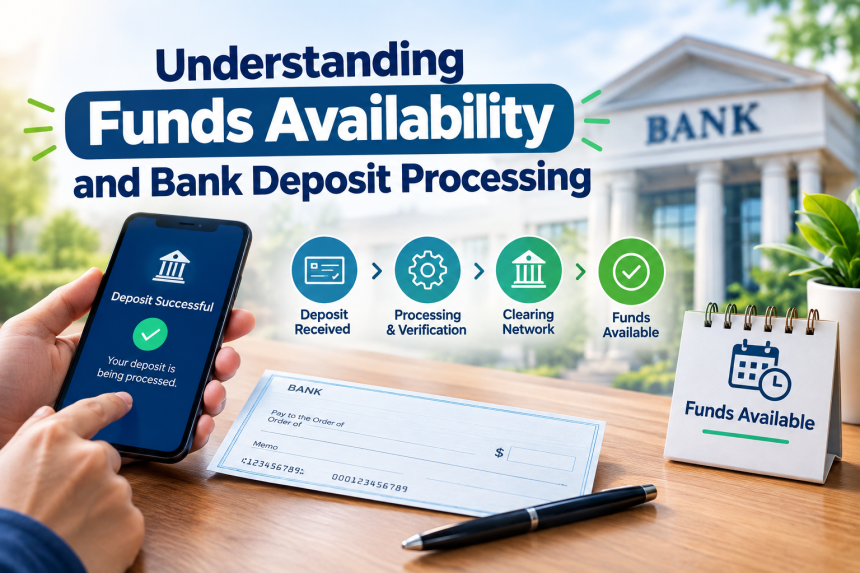
Introduction
When you deposit a check or other payment into your bank account, you may expect the money to be available right away. In reality, banks often need time to process deposits before you can use the full amount. This is where funds availability rules become important.
Understanding how deposit processing works can help you avoid declined payments, unexpected account shortages, and confusion about when your money is actually ready to spend. In this guide, you will learn how banks determine when deposited funds become available, how check deposits are handled, and why a bank may place a temporary hold on your money.
What Is Funds Availability?
Funds availability refers to when money deposited into a bank account becomes available for withdrawal or other transactions.
A bank may receive your deposit immediately but still need time to verify and process it. For example, a check may need to be sent through the banking system so the issuing bank can confirm that the funds are legitimate.
The availability period can depend on several factors, including:
- The type of deposit
- The amount deposited
- The method used to make the deposit
- The time and day of the deposit
- Whether the account is new
- The bank’s applicable policies
- Whether unusual circumstances require additional processing
Therefore, the date you make a deposit is not always the same as the date you can freely use the money.
How Long Does a Deposited Check Take to Clear?
One of the most common questions is, how long does a deposited check take to clear?
In many ordinary situations, some or all of a check deposit may become available within one or two business days. However, the exact timing varies depending on the bank, deposit type, amount, and other circumstances.
For instance, depositing a check before a bank’s cutoff time on a business day may allow processing to begin sooner than a deposit made after the cutoff. A weekend or federal holiday can also affect the timetable because banks generally process deposits according to business-day schedules.
It is also important to understand that funds being available does not necessarily mean the check can never be returned. A check may still be reversed if the payment is later rejected or another problem is discovered.
If I Deposit a Check, When Will It Be Available?
The answer depends on your bank and the circumstances surrounding the deposit.
Before spending a large check deposit, check your bank’s availability notice or account information. Your bank should provide information about when deposited funds are expected to become available.
If you need the money for an important payment, do not assume that the entire deposit can be used immediately.
What Is a Reg CC Hold?
A Reg CC hold generally refers to a temporary hold placed on certain deposits under rules associated with Regulation CC, which governs the availability of funds deposited into transaction accounts in the United States.
These rules establish general requirements for when banks must make certain deposited funds available. However, specific exceptions can allow a bank to delay availability in particular situations.
For example, additional delays may apply in circumstances involving:
- Large deposits
- Repeated overdrafts
- New accounts
- Checks that may require additional verification
- Emergency conditions
- Reasonable concerns about collectability
The bank should generally provide appropriate notice when a longer hold applies.
Why Do Banks Place Holds?
Banks place holds because a deposited check is not always equivalent to cash. The bank may need confirmation that the issuing account has sufficient funds and that the check is valid.
Without reasonable processing procedures, banks would face greater risks from returned checks, fraud, and other payment problems.
A hold gives the banking system time to complete necessary processing before the money is fully available.
How Long Do Checks Take to Deposit?
People often use the phrase “how long do checks take to deposit” when they actually mean two different things: how long it takes for the bank to accept the deposit and how long it takes for the funds to become available.
These are not necessarily the same.
A mobile banking app, ATM, or teller may accept your check quickly. However, the bank may still place a hold on some or all of the deposit.
Mobile Check Deposits
Mobile deposits can be convenient because you can submit a check without visiting a branch. However, availability depends on the bank’s mobile deposit policy and the time the deposit is submitted.
Always review the confirmation message provided by your bank. It may show an estimated availability date.
ATM and Branch Deposits
Deposits made at a branch or ATM can also have different processing schedules. A deposit made after the institution’s cutoff time may be treated as being received on the next business day.
This is why checking your bank’s cutoff times can be useful when you need access to money quickly.
What Is the Expedited Funds Availability Act?
The Expedited Funds Availability Act (EFAA) is a U.S. federal law designed to establish rules concerning how quickly banks must make certain deposited funds available to customers.
Regulation CC implements the EFAA and provides requirements related to funds availability and check collection.
The rules can be detailed, and exceptions may apply. Therefore, consumers should not assume that every check or deposit follows exactly the same schedule.
For everyday banking, the most useful approach is to check the availability information supplied by your bank for each deposit.
How to Avoid Problems With Deposit Holds
A deposit hold can be frustrating, particularly when you need the money for bills or other expenses. A few simple habits can make the process easier.
Check the Availability Date
After making a deposit, look at your receipt, mobile banking notification, or online account information. This can help you determine when the funds should become available.
Know Your Bank’s Cutoff Time
Depositing a check earlier in the day may help you avoid unnecessary processing delays. Ask your bank about its cutoff times for branch, ATM, and mobile deposits.
Keep Enough Money for Important Payments
If a check is subject to a hold, avoid scheduling payments based on the assumption that the money is already available.
Maintaining a small financial cushion can help prevent overdrafts and declined transactions.
Contact Your Bank When Something Looks Wrong
If the expected availability date passes and your funds are still unavailable, contact your bank. Ask why the hold remains and whether additional information is required.
Keeping your deposit receipt can also make it easier to discuss the issue with a representative.
Common Questions About Funds Availability
How long does a deposited check usually take to clear?
Many standard check deposits become available within a few business days, but the exact period depends on the bank, deposit type, timing, and applicable exceptions.
Can a bank hold a check deposit?
Yes. Banks can place holds on certain deposits when permitted under applicable funds availability rules. The bank may provide a notice explaining the hold and expected availability date.
Does a weekend count as a business day?
Generally, Saturdays, Sundays, and federal holidays are not treated as business days for many banking availability calculations. This can affect when deposited funds become available.
Why is my check deposit still pending?
A deposit may remain pending because it is still being processed or because a hold has been plqwaced. Contact your bank if the delay extends beyond the expected availability date.
Does available balance mean the check has completely cleared?
Not necessarily. Available funds indicate money that the bank currently allows you to use, but a deposited check can sometimes be returned later.
Conclusion
Understanding funds availability can make everyday banking much easier. A deposited check may be accepted immediately, but the money may not be fully available until the bank completes its required processing.
Factors such as deposit type, timing, account history, holidays, and applicable exceptions can affect the schedule. If you are depositing a large check or need the money for an important payment, always check the availability date provided by your bank rather than making assumptions.