



Introduction
Imagine living in a world where sending a message to someone far away could take days or even weeks. Before the telephone, people relied on letters, messengers, and telegraphs to communicate across long distances. The invention of the telephone completely changed this situation by allowing people to hear each other’s voices from different locations.
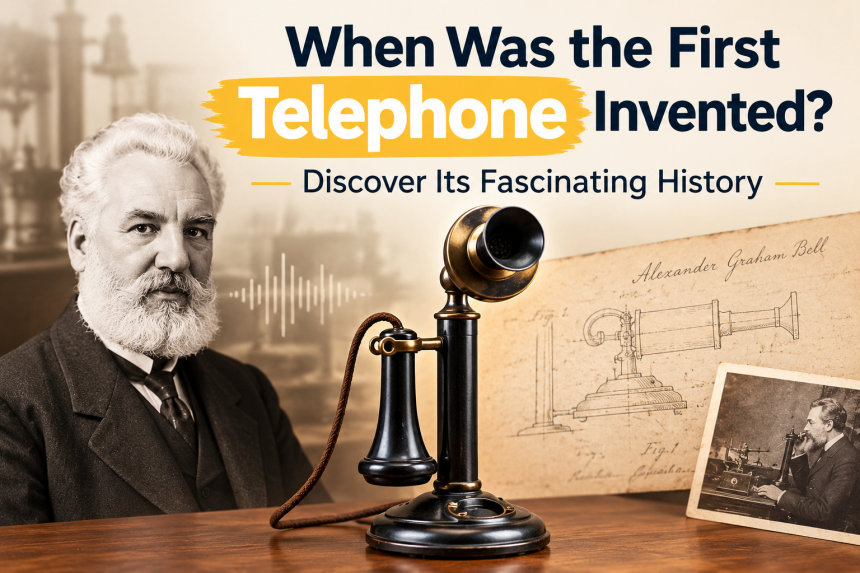
So, when was the telephone invented? Alexander Graham Bell successfully introduced the first practical telephone in 1876, marking a major milestone in communication history. His invention introduced a new era of communication and laid the foundation for modern telephone technology.
In this article, we will explore the telephone’s invention, its creator, the important historical dates, and how this remarkable device evolved into the smartphones we use today.
When Was the Telephone Invented?
The telephone was invented in 1876, when Alexander Graham Bell successfully developed a working device that transmitted human speech electronically.
On March 7, 1876, Bell received a United States patent for his telephone design. Just three days later, on March 10, he demonstrated the device by transmitting the famous message to his assistant, Thomas Watson.
This achievement marked an important turning point in communication history. Unlike the telegraph, which transmitted coded messages, the telephone allowed people to communicate using their natural voices.
What Year Was the First Phone Invented?
The year 1876 is widely recognized as the year the first practical telephone was invented. Although several inventors were experimenting with sound transmission before Bell, his successful device helped establish telephone communication as a practical technology.
His invention made it possible to send spoken words through electrical signals using connected wires.
Who Invented the Telephone?
Alexander Graham Bell is commonly recognized for developing the world’s first practical telephone. He was a Scottish-born inventor, scientist, and teacher who dedicated much of his work to sound, speech, and communication.
<escape> </escape>
Alexander Graham Bell was born in Edinburgh, Scotland, on March 3, 1847. His family had a strong interest in speech and communication, which influenced his scientific work.
Before developing the telephone, Bell studied sound transmission and worked with people who had hearing and speech difficulties. These experiences helped him understand how sound could be converted into electrical signals.
How Did Alexander Graham Bell Invent the Telephone?
Bell’s work focused on transmitting different sound frequencies through electrical currents. He believed that electrical signals could carry the patterns of human speech from one location to another.
With assistance from Thomas Watson, Bell developed a working telephone device. Their experiments eventually led to the successful transmission of spoken words in March 1876.
His invention was not created overnight. It resulted from years of experimentation, scientific knowledge, and collaboration.
When Did Bell Successfully Create the First Telephone?
Alexander Graham Bell achieved his major telephone breakthrough in March 1876.
Two important dates explain the invention:
- On March 7, 1876, Alexander Graham Bell was granted U.S. Patent No. 174,465 for his telephone invention. 174,465 for his telephone invention.
- March 10, 1876: Bell successfully transmitted spoken words to Thomas Watson during an experiment.
Bell’s historic first telephone message to Thomas Watson is remembered as: “Mr. Watson, come here, I want to see you.”
This short sentence became a historic moment because it demonstrated that human speech could travel through an electrical communication system.
Why Was the 1876 Telephone Patent Important?
Bell’s patent established legal recognition for his telephone design in the United States. However, the invention’s history also involved other researchers who explored similar technologies.
Elisha Gray, Antonio Meucci, and other inventors contributed to early developments in voice transmission. Their work is an important part of understanding how telephone technology emerged.
How Did the First Telephone Work?
The first telephone worked by converting sound vibrations into electrical signals and then changing those signals back into sound at the receiving end.
When someone spoke into the transmitter, their voice created vibrations. These vibrations influenced an electrical current that traveled through a connected wire.
At the other end, the receiver converted the electrical changes into sound, allowing another person to hear the original speaker.
Main Parts of Early Telephones
Early telephone systems were much simpler than modern devices. However, they contained several important components:
- Transmitter: Converted the speaker’s voice into electrical signals.
- Receiver: Turned electrical signals back into audible sound.
- Connecting wires: Carried signals between two telephone devices.
- Power source: Supported the electrical operation of the system.
These basic principles helped shape later telephone designs and communication networks.
How Did Telephones Develop After 1876?
The telephone’s invention marked the starting point of a remarkable journey in communication technology. Over the following decades, engineers introduced improvements that made telephone communication more accessible, reliable, and convenient.
Early Telephone Exchanges
In the late 1870s, telephone exchanges began connecting multiple users through central switching systems. Instead of having a direct wire between every pair of users, operators helped establish connections.
This development made telephone networks easier to expand.
Introduction of Rotary Dial Phones
During the early 20th century, rotary dial telephones became increasingly common. Users could dial numbers themselves instead of depending entirely on telephone operators.
This change made calling more convenient and helped telephone services reach more households.
The Rise of Mobile Phones
Mobile communication introduced another major transformation. Early mobile phones were large, expensive, and mainly used in vehicles or specialized settings.
Over time, improvements in batteries, electronics, and wireless networks made mobile phones smaller and more affordable.
Today, smartphones combine telephone communication with internet access, cameras, navigation, and countless other features.
Early Inventors Who Paved the Way for the Telephone
Although Alexander Graham Bell is widely recognized for developing the first practical telephone, several inventors contributed to the technology before and around 1876.
Antonio Meucci experimented with voice communication devices during the 1850s and 1860s. Elisha Gray also developed telephone-related technology and submitted a patent caveat on February 14, 1876, the same day Bell’s patent application was filed.
These developments show that telephone invention was part of a wider period of scientific experimentation.
It is important to distinguish between early ideas, experimental devices, and the successful patented telephone system associated with Bell.
How the Telephone Transformed Communication Around the World?
The telephone changed how people communicated, conducted business, and maintained relationships. Before its arrival, long-distance conversations were impossible without meeting in person.
Its introduction created several important benefits:
- Faster communication: People could exchange information immediately through spoken conversations.
- Business development: Companies could communicate with customers, suppliers, and employees more efficiently.
- Emergency response: Telephone networks made it easier to report accidents and request assistance.
- Personal connections: Families and friends could stay in touch across long distances.
- Technological progress: Telephone research helped support later developments in telecommunications.
The telephone also influenced the development of radio communication, mobile networks, and modern digital technology.
Frequently Asked Questions
When Was the Telephone First Invented?
The first practical telephone was invented in 1876 by Alexander Graham Bell. He received his patent on March 7 and successfully transmitted speech on March 10.
Who Invented the Telephone in 1876?
Alexander Graham Bell is best known for creating the first telephone that made voice communication practical. He worked with his assistant Thomas Watson during its development.
When Were Telephones Invented and First Used?
Telephones were invented in 1876, and commercial telephone services began expanding in the late 1870s. Early systems connected users through wires and telephone exchanges.
What Was the First Telephone Message?
On March 10, 1876, Alexander Graham Bell made history by transmitting the first successful telephone message to his assistant, Thomas Watson: “Mr. Watson, come here, I want to see you.”
Did Alexander Graham Bell Invent the First Mobile Phone?
No. Bell invented the practical telephone in the 19th century. Mobile phones were developed much later through advances in wireless communication and electronics.
Conclusion
The answer to when the telephone was invented is 1876, when Alexander Graham Bell developed a successful device capable of transmitting human speech. His work transformed communication and opened the door to the telephone networks and mobile technologies used today.
From simple wired devices to advanced smartphones, telephone technology has continued to evolve for nearly 150 years.
Understanding this history helps us appreciate how one invention changed everyday life around the world.