



Introduction
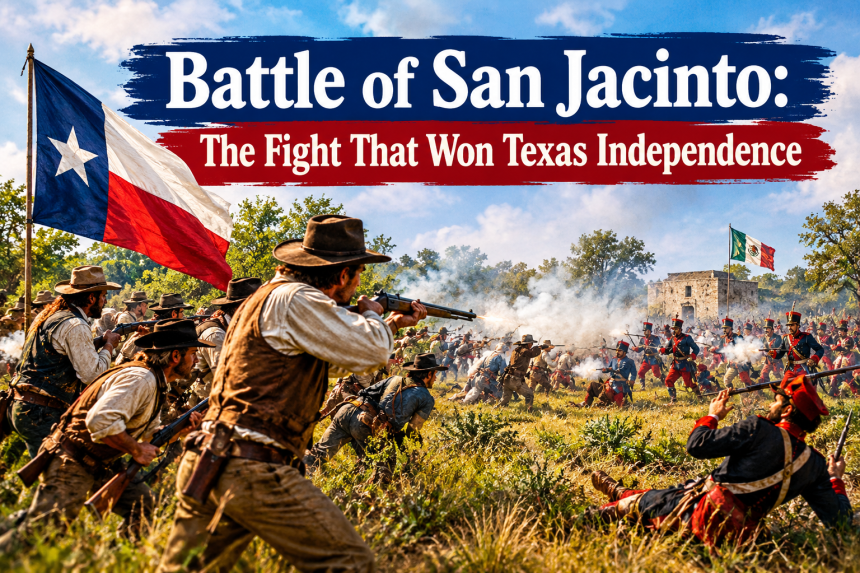
The battle of san jacinto was a turning point in American and Texas history. Fought on April 21, 1836, near present-day Houston, Texas, this short but decisive battle helped secure independence for the Republic of Texas from Mexico. Although the Texan army faced a larger Mexican force during the Texas Revolution, its commander, Sam Houston, used careful timing and a surprise attack to change the course of the conflict.
The battle lasted only about 18 minutes, but its consequences extended far beyond the battlefield. Mexican General Antonio López de Santa Anna was captured, and the defeat forced Mexican leaders to confront the growing independence movement in Texas.
In this article, you will learn what the Battle of San Jacinto was, why it happened, who won, and how it shaped the future of Texas.
What Was the Battle of San Jacinto?
The Battle of San Jacinto was the decisive military engagement of the Texas Revolution, a conflict between Texian independence forces and the Mexican government. It took place near the San Jacinto River and Buffalo Bayou, in what is now southeastern Texas.
The battle followed months of fighting between Mexican troops and settlers who wanted greater political control or independence from Mexico. By early 1836, the conflict had become increasingly violent. Mexican forces had defeated the Texian defenders at the Alamo in March, while Texian troops continued to organize resistance.
Key Facts About the San Jacinto Battle
| Detail | Information |
|---|---|
| Date | April 21, 1836 |
| Location | Near the San Jacinto River, present-day Texas |
| Conflict | Texas Revolution |
| Texian commander | Sam Houston |
| Mexican commander | Antonio López de Santa Anna |
| Result | Decisive Texian victory |
| Main consequence | Texas gained the opportunity to establish independence |
The Texian army included volunteers and settlers who supported independence. The Mexican army was a professional military force under Santa Anna. Although the two sides differed in size, training, and experience, the outcome depended heavily on timing, battlefield decisions, and the element of surprise.
Why Did the Battle of San Jacinto Happen?
To understand why the battle occurred, it is important to look at the political tensions that developed between Texas settlers and the Mexican government.
Growing Tensions Between Texas and Mexico
In the 1820s and early 1830s, many American settlers moved into Mexican Texas. Over time, disagreements developed over immigration rules, trade, cultural differences, and the Mexican government’s increasing centralization of political power.
In 1835, armed resistance broke out. Texian rebels challenged Mexican authority, and the conflict developed into the Texas Revolution. Some participants initially wanted to restore the Mexican Constitution of 1824, while others increasingly supported complete independence.
On March 2, 1836, delegates gathered at the Convention of 1836 and officially proclaimed Texas an independent republic, breaking away from Mexican rule.
The Alamo and the Runaway Scrape
The Mexican army captured the Alamo in San Antonio on March 6, 1836, killing its defenders. The loss became a powerful rallying point for Texian resistance.
Soon afterward, Santa Anna’s forces continued advancing through Texas. Sam Houston’s army retreated eastward while preparing for another opportunity to fight. Many civilians also fled their homes to escape the approaching Mexican army. This movement became known as the Runaway Scrape.
Houston’s retreat frustrated some Texians, who wanted an immediate confrontation. However, he was trying to preserve his army and choose a battlefield where his troops could fight effectively.
By April, the two armies had moved into the area around the San Jacinto River. Everything was in place for a decisive clash that would shape the course of the revolution.
How the Battle of San Jacinto Unfolded
The events of April 21, 1836, explain why a brief engagement had such a lasting impact on Texas history.
Sam Houston’s Plan
Sam Houston understood that his army needed an opportunity to defeat Santa Anna’s forces without suffering the losses that a prolonged battle could cause. He moved his troops through the region while monitoring the Mexican army’s position.
Santa Anna had established a camp near the San Jacinto River. His troops had experienced a demanding campaign, and the Mexican position offered Houston an opportunity to launch an unexpected attack.
Houston’s men included infantry and cavalry, and some Texian troops carried rifles and other firearms. The Texian army also had two small cannons known as the Twin Sisters, although accounts differ about their exact use and effectiveness during the engagement.
The Surprise Attack on April 21
During the afternoon of April 21, Houston ordered his troops to advance toward the Mexican camp. The Texians approached through terrain that helped conceal their movements.
The Mexican forces were not fully prepared for the sudden assault. Texian soldiers attacked rapidly, shouting battle cries commonly remembered as “Remember the Alamo!” and “Remember Goliad!” These phrases referred to earlier losses suffered by Texian forces.
The attack quickly disrupted the Mexican camp. Texian troops overwhelmed the defenders, and the fighting turned into a rout. Many Mexican soldiers were killed, wounded, or captured as they attempted to escape.
The main battle lasted approximately 18 minutes, although pursuit, killing, and capture continued afterward. The brevity of the engagement should not hide its brutality or the wider consequences for both armies.
Who Won the Battle of San Jacinto?
The Texian army, commanded by Sam Houston, won the Battle of San Jacinto on April 21, 1836. Its surprise attack defeated Santa Anna’s Mexican force and led to the capture of the Mexican president and general the following day.
The Capture of Santa Anna
After the battle, Santa Anna escaped the initial fighting but was captured on April 22, 1836. His capture gave the Texians significant leverage over the Mexican command.
Houston’s forces had suffered comparatively few casualties during the main engagement, while the Mexican army suffered heavy losses. Historical estimates vary, particularly for Mexican casualties and the number of soldiers captured, so exact totals should be treated cautiously.
The victory changed the military situation almost immediately. Santa Anna’s capture weakened Mexico’s ability to continue the campaign in Texas and allowed the Texian leadership to negotiate from a stronger position.
What Happened After the Victory?
Santa Anna signed the Treaties of Velasco in May 1836. The agreements provided for an end to hostilities and Santa Anna’s withdrawal, although the Mexican government later refused to recognize Texas independence under the treaties.
The Republic of Texas nevertheless operated as an independent state after the revolution. Texas remained independent until it joined the United States in 1845, a development that contributed to growing tensions between the United States and Mexico and preceded the Mexican-American War.
The battle therefore marked a major step toward Texian independence, but it did not immediately settle every political or territorial dispute between Mexico and Texas.
Why the Battle of San Jacinto Matters Today
The significance of the battle goes beyond the military victory itself. It influenced Texas’s political future and became a lasting symbol of independence.
It Secured the Path to Texas Independence
Before San Jacinto, the Texian army faced a serious threat from Santa Anna’s campaign. The victory destroyed the immediate momentum of the Mexican offensive and gave the independence movement a realistic opportunity to survive.
Although Mexico did not formally accept Texas independence, the Republic of Texas established its own government and maintained a separate political identity for nearly a decade.
It Shaped the History of the United States and Mexico
Texas independence eventually led to annexation by the United States in 1845. Mexico opposed the annexation, and disputes over the border helped trigger the Mexican-American War in 1846.
The conflict that followed reshaped the boundaries and political relationships of North America. For this reason, the Battle of San Jacinto is an important event not only in Texas history but also in the broader history of the United States and Mexico.
The San Jacinto Monument and Historic Site
Today, visitors can explore the San Jacinto Battleground State Historic Site near La Porte, Texas. The site includes the San Jacinto Monument, a towering memorial commemorating the battle and the struggle for Texas independence.
The surrounding area offers opportunities to learn about the battle, view historic exhibits, and understand the landscape where the fighting took place. Visiting the site can help bring the events of 1836 into clearer perspective.
Frequently Asked Questions
1. When Was the Battle of San Jacinto Fought?
The battle took place on April 21, 1836, during the Texas Revolution. The Texian army launched a surprise attack on Mexican troops near the San Jacinto River.
2. Who Won the Battle of San Jacinto?
The Texian army led by Sam Houston won the battle. Its victory resulted in the capture of Mexican General Antonio López de Santa Anna and helped secure the path to Texas independence.
3. How Long Did the Battle of San Jacinto Last?
The main battle lasted approximately 18 minutes. However, fighting, pursuit, and the capture of Mexican soldiers continued after the initial attack.
4. Why Was the Battle of San Jacinto Important?
The victory ended Santa Anna’s immediate campaign to suppress the Texas rebellion and strengthened the Texians’ ability to establish an independent republic. It also influenced later relations between Texas, Mexico, and the United States.
5. Did Mexico Recognize Texas Independence After the Battle?
No. Although Santa Anna signed the Treaties of Velasco in May 1836, the Mexican government did not recognize Texas independence. Texas continued as a separate republic until its annexation by the United States in 1845.
Conclusion
The battle of san jacinto was a defining moment in the Texas Revolution. On April 21, 1836, Sam Houston’s army used a surprise attack to defeat Mexican forces and capture General Santa Anna. The victory transformed the independence movement and allowed the Republic of Texas to emerge, despite Mexico’s continued refusal to recognize its independence.
The battle’s effects extended into later decades, influencing the relationship between Mexico and the United States and shaping the history of the region.
Want to learn more about Texas history? Explore other important events of the Texas Revolution, including the Battle of the Alamo, the Goliad Campaign, and the declaration of Texas independence, to understand how these events shaped the region’s future.